Showing posts with label Theory and Practices. Show all posts

Sunday, August 15, 2021

on wamandada_🌿

a singer and lyricist who had brilliance in writing and articulating the complex questions mere in two or three simple lines, which any lay-person could understand and relate to. he was also a social transformer whose life had in long-span revolutionized the marathi musical traditions, specifically the folk-music.

his songs, ghazals, and bhim-geete represented the glimpses of life, suffering, pain, and happiness of the working and oppressed classes, along with the gratitude towards the revolutionary leaders like babasaheb, ramai, jyotiba, sau etc.

while talking about pain and suffering, his lyricistical visualization of the masses never undermined them to inferior to others. because the basis for his writing was “manuski” aka humanity.

because of his tremendous contribution to the social sphere aligned with bhim geete, people called him “yug kavi”, i.e. the poet of this age.

📑 on wamandada_
🖋 @dnyanesh_____
yug kavi, wamandada kardak


Friday, June 26, 2020

cosmic laborers_🌿

gazing at stars, the moon, and even the little tinkling objects in the sky at nights have been the best play that i could fantasize since childhood. always wondering to imagine where do all they live? what do all they do? do they talk to each other? do they all have any language? and so many questions likewise.

more than that, i had my own theories to justify their relations with me. that, they all go to work as laborers in the daytime. just like i go with mumma-bappu, and they might be coming back to their sky-home in the night to rest, that too like me.

such a fun it was! now i think of it with so much existing knowledge like cosmology, big-bang, and so on. but i don't know why they always keep me away from the theories that I intended to articulate in childhood. ~

📑 cosmic laborers_
🖋 @dnyanesh_____

a star and the gossips and the theories


Tuesday, June 2, 2020

un-layering learnings_🌿

we tend to forget many stories by layering our realities with new learnings, new language, and new knowledge. However, it seems a natural process but it must also be seen critically from a pedagogical perspective.

communities like dalit that have been epistemologically muted for centuries; are in the ambit of continuous subjugation for multiple reasons. one of them is that they are yet to form alternative discourses, perspectives, concepts, categories, methodologies, frameworks, etc. in short, they have to strive for "alternative knowledge systems."

this argument may sound against modernity, rather going back to past may feel like no need to reveal the painful history; instead, this is not. apart from the importance of building alternative knowledge systems, one has to know understand three important processes while decoding the context namely: "freedom of mind," "inventive mind," and "navayana."

freedom of mind: it is the process of realizing one's own ontological beingness. It sets the norm or a bottom line, "all are humans, and nobody is inferior to others." but mere this is not enough. a learner also has to act to propagate this idea. by acting, it means rejecting knowledge systems that affirm oppression and inferiority.

inventive mind: a mind that seeks "newness". it leads the person to invent ideas and formulate new "visionary epistemologies" that can connect the past and present with the future.

navayana: navayana is a dynamic process (changes with said contemporary situations) that parallelly conglomerates the above two processes to formulate the "alternative knowledge system." it opens up a cosmos to learn and build more alternative knowledge systems.

📑 un-layering learnings
🖋 @dnyanesh_____


Thursday, May 14, 2020

annihilation of caste: more than a speech_🌿

i have always been fascinated by this book "annihilation of caste" of dr babasaheb ambedkar. Not only because it is an academic masterpiece or a reference to the core of so many socio-political movements but it is also one of the most sold, debated, interpreted book than any other academic book.

though at the outset, it is written in the manner of a public speech, as said in the title as "speech prepared but undelivered" or even if any reader knows the context of publishing this speech into a book, may understand that it is a speech. 

what i see in this book is that it is a balance of academic sophistication, normative reasoning and simplicity of writing, so that it can be understood by all, the activists, academicians as well as the common masses.

this is a list of sources from which one could holistically visit this book with almost all contemporary debates that are happening. Annihilation of Castes: Text, Context and Theory (List of Sources) 
 ðŸ“‘ annihilation of caste
🖋 @dnyanesh_____

 
annihilation of castes, the first edition


more readings and audios of babasaheb's writing

(it is a separate site called "reading babasaheb" where both pdf and audios of babasaheb has attached. if one-click on the topic the audios of each topic will open in soundtrack app and by clicking on the main topic of the volume, the pdf will open)


Thursday, April 30, 2020

xuan zang_📑

at the outset, this movie is worth-to-be-watched. It has a comprehensive visual graph of xuan zang's journey and the contemporary socio-cultural, geopolitical, and philosophical glimpses that existed in the 19 years of the storyline that the scriptwriter and the director have chosen to show in this movie.

the immediate vibrations that i felt while resembling a few words and subtitles from the film were "dharma", "slaves," etc. it was astonishing to interpret whether they are taken the same as "dhamma", "untouchables/achoot"? if yes, why are they being replaced interchangeably? likewise, the usage of the word "god" by xuan zang was a point to consider in the same line of inquiry.

what is more interesting i saw, which i was expecting more descriptively, but the movie restrained only to two points, was the debate between mahayana and hinayana. the film emphasized more on xuan zang's scholarly understanding that 1) hinayana is more individualistic and abstract. in contrast, the mahayana is more extensive in assimilating 'others' into the 'self'. 2) hinayana believes that the 'universe' is material. but 'perception' is illusionary. while mahayana believes both are mutable and illusionary.

mahayana sees the universe's true face_ all is mutable, and all is illusionary. this point was profound for me, and i think i need to follow them through readings and processes. the missing thing i felt within this debate was pranagupta's critique of mahayana. it was mentioned but not explained.

📑 xuan zang_
🖋 @dnyanesh_____
🌱 read this piece on blogspot, link is in the bio.


The movie, Xuan Zang.

Tuesday, April 14, 2020

On Post-Structuralism

When it comes to post-structure; to my knowledge from the sociological point view, it appears as a perspective that deconstructs and decodes the "meta-narrative" of existing paradigms that originated in the land of hegemonic epicentres of knowledge. Be it functionalism, symbolic interactionism or even the Marxist paradigms.

What evolved in my mind during this lecture was that there is a more deep vacuum in btw that has to be understood. Articulating conventional and analytical school of thoughts as ontological and epistemological processes respectively, brought more clarity on my understanding about what a 'post-structure' is and what it intends to be. I need more cultivation of mind to process it further. However, a general idea premise I saw in the lecture but was too more focused on the 'metaphysical' and 'normative' arena of post-structure.

The reflection came from an article that I read a few weeks ago in a "science" magazine, which forced me to look at whether a similar debate exists in physical science also? It is still in bits and pieces in my mind but I will try and explain it with best of my capacities.

The idea of binaries in general and its epistemological processes, i.e. signifier and signified, linguistic dynamics etc. might be seen in the realm of the debates that are currently happening in the contemporary modern science (physics), specifically in the recent studies on quantum physics.

The research indicates that quantum physics essentially studies what consists in an atom and even deeper micro-universe within now exist differently in 'strange-metals'. Which proves that there are linkages between 'quantum physics' and 'entanglement' for which cascade of electrons is the best evidence.

Now, The historical practice of looking at quantum from microscopic lenses has been questioned and is turning into understanding quantum in the macroscopic dynamics also. Here, the question comes in between, how is the physical science addresses the macroscopic quantum or the quantum criticality in 'strange metals'. There might be no conventions that are existing ontologically or no analytics can explain its epistemology. It is yet to find whether there are and are no binaries in them. Let us hypothesized that there is no binary, then it proves that post-structure flops here!

Reflection is still moving and changing just like a process that doesn't end!


Saturday, January 4, 2020

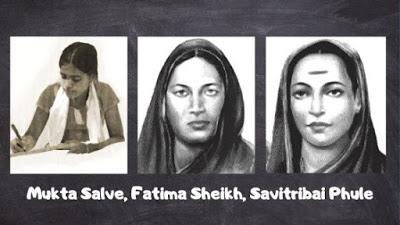
The Trio of Mukta Salve, Fatima Shaikh and Savitribai Phule


The relevance of this "trio", i.e. Mukta Salve, Fatima Sheikh and Savitribai Phule (three significant persons together) have gained a lot more visibility on this birth anniversary of Dnyanjyoti Savitribai Phule on 3rd January 2020. What is more significant to see is that― this recognition has also been seen as a "conglomeration" of diverse "oppressed realities" brought on one platform. In this context, the paper attempts to revisit the importance of their personality and work. At the same time, the article also tries to navigate the "socio-political distinctions" as well as "togetherness" among them which then can be acknowledged in the light of Dalit, Muslim-Bahujan, Bahujan Movements and then in broader movement of social justice and social transformation.


Mukta Salve [1841-1855*][1]

In times, when the society in Pune was at the highest peak of caste orthodoxy and super rigid about untouchability in its inhuman form, a 14 years old girl child, Mukta Salve wrote an essay titled 'Mang Maharachya Dukhvisayi' or About the Grief of the Mang and the Mahars". The title Salve can be found in most of the families of Mang sub-caste in the former “Ati-Shudra” and today's Dalits and Nav-Budhhists in Maharashtra.[2] The essay was published in a fortnightly journal namely 'Dnyanodaya'; in two parts. The first part was released on 15th February 1855 and second was on 1st March of 1855. [Narake, 1998]

Mukta Salve was a student of one of the three girls schools[3] that were started by Savitribai and Jotirao Phule. The essay was penned in the form of a memoir, an autobiographical piece in which Mukta Salve nailed out the monopoly of Brahmins in Hindu religion and Vedas in particular, whose imposition has led to the plight of Mang and Mahar Castes (the Ati-shudra and untouchable castes). [ibid] Taking note from her essays, she elucidates,

"लाडूखाऊ ब्राह्मण लोक तर म्हणतात की, वेद ही आमचीच मत्ता आहे. ब्राह्मणेत्तरास वेदाचा अधिकार नाही. यांजवरून जर आम्हा धर्म पुस्तक पाहण्याचा मोकळीक नाही, तर आम्ही धर्मरहित आहोत असे साफ दिसते की नाही बरे? हे भगवाना, तुजकडून आलेला कोणता धर्म आम्ही स्वीकारावा, ते लवकर कळीव म्हणजे तेणेप्रमाणे तजवीज करता येईल!"
~ मुक्ता साळवे, ज्ञानोदय, १५ फेब्रुवारी १८५५, अहमदनगर 
"These sweetmeats gobbling Brahmans say that the Vedas are only their monopoly. The non-Brahmins have no right to study the Vedas. Does this not prove that we are without religion since we have no opportunity to even look at the religious texts? Oh God, please let us know soon which religion is coming from you and should be followed so that we can make arrangements thereof."
~ Mukta Salave, Dnyanodaya, 15th February 1855, Ahemednagar

Mukta's essay precisely articulates the monopoly of Brahmin over Vedas. The non-Brahmin castes are not allowed to see the Vedas. The sub-castes within “Ati-shudra” such as people belonging to the Mang and Mahar castes were not even allowed to see Vedas. Being a person from an untouchable caste [4], she didn't have those rights; if not, she smartly questioned her people consider Vedas to be their religion, where they could neither know nor have right to know what they follow and believe. Authoritative castes like Brahmin only have the right to study Vedas. She brings clarity in the matter of social locations of “Ati-Shudra” within the Chaturvarna and asserts that if the Mang and Mahar don't have the right to even see the sacred text, she says not to follow such religion.

In the essay very critically, Mukta Salve looks at the castes system where the untouchables don't have a religious identity like others. She protests to God for vanishing the existence of such a religion from the earth where only one person is privileged, and the rest are deprived.

"Muslims lead their lives according to their Kuran, English people follow their Bible and Brahmans have their own Vedas. Because they all have their own good or bad religion that they follow, they are somewhat happier than us who are without any religion. Oh, God, please tell us, what is our religion? Teach us, O God, your true religion so that we all can lead our lives according to it. Let that religion, where only one person is privileged, and the rest deprived, vanish from the earth and let it never enter our minds to boast of such a (discriminatory) religion." [Savari Editorial, 2015; Mani & Sardar 2008]
Mukta has also highlighted the mental illness and she questions the contemporary consciousness of Mahar and Mangs. The Mahar caste, which is also an untouchable caste, considers Mang as lower to them. Mukta assesses their plight very carefully and enlightens them by offering a diagnose a medicine of education to their mental slavery.

"Oh, the mahars and mangs, you are poor and sick. Only the medicine of knowledge will cure and heal you. It will take you away from wild beliefs and superstitions. You will become righteous and moral. It will stop exploitation. People who treat you like animals, will not dare to treat like that any more. So please work hard and study. Get educated and become good human beings." [ibid]

Fatima Sheikh (1850s*]

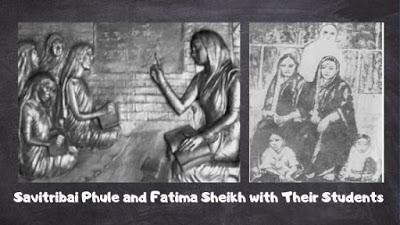
Fatima Sheikh was a noble person who gave her own house to Savitribai and Jotirao Phule to start a first-ever school called "Indigenous Library" in Bhidewada, Pune. Her brother Usman Sheikh has supported Fatima for her decisions to work with the Phule couple. Very less literature recognises her contribution to the social changes that took place then. Fatima Sheikh and Savitribai, both took the forefront role in establishing schools and taught to the girls as well as boys. Not only has she fought against castes Hindu-Brahmins in her association with Phule couple but also the orthodox Muslim who stood against the education of girls and untouchables. [Khan, 2017]

Due to the presence of Fatima Sheikh and Savitribai Phule, the number of girls students had increased in schools. For example, in Chiplunkar Wada, they started a school on 3 July 1851. Initially, the number of girls students was only 8. Very soon the number increased to 48 in 1852. It can also be said that due to the presence of Fatima Sheikh, the education could reach especially to girls of Muslim families. [Narake, 1998]


Savitribai Phule (1830-1897]

Savitribai was the first headmistress of the girl's school, started in 1848. She was born on 3rd, January 1830 in the family titled Nawashe Patil of Naigaon which is near Shirval and 50 Km from Pune (Narake, 1998) There is no clarity about her maternal caste location but her husband, Jotirao Phule belonged to the 'Mali' caste which is considered as one of the castes in 'Shudra Varna', imposed to be at the fourth level in the hierarchy of 'Chaturvarna'. Most of the literature acknowledges that this school was the first girl's school in modern India. [ibid]

Apart from being an educationist, Savitribai was a poetess too. Today, two collections of Savitribai's poems are available. One of them is 'Kavyaphule'. It had written in 1854, and the second one is the 'Baavannakashi Subodh Ratnakar' written in 1882. It is assumed that there might be more such writing pieces of Savitribai but yet to be available. However, there also exists the controversy whether the literature was written by Savitribai Phule. (Mali, 1988)


In the year of 1848-55, the Savitribai Phule with Jotirao Phule started three schools. In 1863, the couple also opened a 'child prevention home' in which Savitribai and Jotiba gave space to mothers and widows who were forced to attempt foeticide by their families. In the wake of severe drought, they released their water well for Ati-Shudras to access drinking water. [ibid].

Savitribai and Jotirao Phule have not got support from many of their relatives and fellow castes people. They moved to the settlements of Ati-Shudras where they had been given a lot of support by the people [ibid]. It was the communities and people from Ati-Shudra settlements who supported the Phule couple to continue their work. In an interview given to Dnyanodaya, a fortnightly on 15 September 1853, Jotirao says,
"It did occur to me that the improvement that comes about in a child due to the mother is very important and good. So those who are concerned with the happiness and welfare of this country should definitely pay attention to the condition of women and make every effort to impart knowledge to them if they want the country to progress. With this thought, I started the school for girls first. But my caste brethren did not like that. I was educating girls and my own father threw us out of the house. Nobody was ready to give space for the school nor did we have money to build it. People were not willing to send their children to school but Lahuji Ragh Raut Mang and Ranba Mahar convinced their caste brethren about the benefits of getting educated."
On 23 September 1873, with the company of her husband, Savitribai started a social movement named 'Satyashodhak Samaj' or 'Truth Seekers Society'. The focus of the society was to awaken Shudra and Ati-Shudra about their oppression in the castes system and untouchability in particular. The movement had also tried looking into more specific issues of women in these groups. They encouraged 'Satyashodhak marriages' in which the bride or groom did neither have to give dowry for marriage nor follow the orthodox social norms. They fought against the priestly domination by organising social-religious ceremonies without them.

The movement got more popularity in Bombay and Pune districts. People from Mali and Kunbi castes then started joining the work of the Phule couple. They mobilised a group of young radicals, mainly Mali's from the cities and Maratha Kunbi from rural areas to fight against the joint exploitation of farmers/ peasantry that was very persistent by the British and Brahmin of that time [Omvedt and Patankar, 2010].

After the demise of Jotirao Phule in 1890, Savitribai took sole responsibility of the 'Truth Seekers Society' and became the leader of the movement. She continued the schools and worked for the movement till her last breath. In a letter to Sayajirao Gaikwad, Mama Parmanand says,

"More than Jotirao, his wife deserves praise. No matter how much we praise her, it would not be enough. How can one describe her stature? She cooperated with her husband completely and along with him, faced all the trials and tribulations that came their way. It is difficult to find such a sacrificing woman even among the highly educated women from upper castes. The couple spent their entire life working for people." 
~ Narayan Mahadev alias Mama Paramanand (31stJuly 1890)
In this trio, one could see the intellectual (epistemological), axiological (ethical) and compassionate leadership led by the women from oppressed sections in the wake of socio-political movements of the nineteenth century.

Endnotes
  1. When the essay was written, Mukta was 14 years old [Narake] So her birth year might be 1942. After the essay, there is no data available about Mukta Salve.
  2. In the same contemporary times, Lahuji Raghoji Salve [1811-1881] a prominent social revolutionary from the Matang Caste has worked with Jotirao and Savitribai Phule. 
  3. There are three schools started by the Phule couple and have been recorded in the data of British Archives. Those are at Chiplunkar Wada, Rasta Peth and Vetaal Peth. It has not been clarified which school Mukta Salve studied. Few claimed that school was the one situated in Vetal Peth. [Garud] 
  4. In the first line itself, Mukta clears that, "It humbles me to realize that God has filled the heart of an untouchable girl like me, considered to be even lower than an animal, with the pain and suffering of my people – the Mahars and Mangs." 
  5. The dates which are starred like this '*' are yet to be confirmed. 

Reference

  1. Salve Mukta, 1855, Translated by Braj Ranjan Mani & Pamela Sardar in the A Forgotten Liberator, the Life and Struggle of Savitribai Phule [2008] reproduced by the Savari Editorials 'Mang Maharachya Dukhvisayi' or About the Grief of the Matang and the Mahars".
  2. Garud Sachin, Mukta Salve: First Voice of Dalit Feminism,[No date has given to these publications] The Academia, The Velivada
  3. Aqsa Khan: Remembering Fatima Sheikh – A Woman Lost In History [2017] Feminism in India
  4. Mandal Dilip: Why Indian history has forgotten Fatima Sheikh but remembers Savitribai Phule [2019] The Print
  5. Jotirao Phule: Shetkaryaca Asud translated as Cultivator’s Whipcord by Gail Omvedt and Bharat Patankar [2010] Round Table India
  6. Narake Hari, Savitribai Phule: Kal Aani Kartutva [1998]; Shatkanchi Shidori Savitribai Phule; Maharashtra Rajya Sahitya Aani Sanskruti Mandal, Mumbai 
This is a live article which means it is in the mode of improvement. With the flow of reading new things will be added or many things can be removed too.

Resources on Mukta Salve, Fatima Shaikh and Savitribai Phule

Sunday, December 31, 2017

In the Mountains of Sahyadri, Blogs on the Field Work

Katkari and Thakur are two very prominent Indigenous/Adivasi communities, whom one could visit and meet in the Western Ghats of Maharashtra. They have been native to southern-west districts like Raigad and Sindhudurg. Katkari Adivasi Societies have a significant presence in the whole of the Western Ghats in general.

The studies of TRTI, Maharashtra have shown that there have been continuing migration of Katkari and Thakur Adivasi families from forests, hills and the peripheries to newly-settled rural, semi-urban and urban spaces. This migration has impacted their visibility in their Adivasi hamlets which are also known as 'Wadi'. Wadi is a native name of a small settlement usually in forests and/or hills where Katkari and Thakur Adivasi live.

Even today, one could see many axiological patterns (consist of culture and aesthetics) of Katkari societies are present in this region. The Adivasi living ways of several small indigenous communities have distinct uniqueness. There is distinctiveness in their styles of celebrating festivals, beliefs which have been carried on from generations to generations except one commonality is that; all of their cultural and social aspects are fundamentally connected to Jal, Jangal, Jamin (water, forests, and land).

Several Adivasi Wadi'es are, at most of the places, situated in the upper part of the hill/mountain area. Thus, it becomes difficult to even walk or take vehicles at that height. However, small narrow and open streets are the best navigators to be used to reach Adivasi Wadis. The ecology of the forests has been drastically changing due to high temperature, low rainfall and things like increment in urbanisation that is impacting on Adivasi living.

Regular engagement of non-Adivasi, both in terms of power and empathy is giving birth to a tremendous epistemic contestation (to save freedom and maintain/counter the complex relationship of integration and negotiation) between Adivasis and the non-Adivasis, basically, outsiders can be seen and studied.

This is a series of blogs consisting of ten articles. It is essential to disclose the fact that these reflections are mine; meaning, of an outsider's reflections. This series has conceptualised and written from the collection of field recordings. It is based on experiences and learnings that the author has collected and gained in the field. The fieldwork had conducted during his master's program of social work course. The objective of the fieldwork was to understand and comprehend Adivasi communities to process the "perspective from within".


In the Mountains of Sahyadri, Blogs on the Field Work


Who am I?

I'm Dnyanesh. I did my masters of arts in the year 2016-18 at TISS, Mumbai. It was the Centre for Social Justice and Governance which gave me an opportunity under the course of Dalit and Tribal Studies to work and learn the fieldwork practitionership. Subsequently, I had got an opportunity to engage with Adivasi communities in the Sahyadri region of Western Ghats.

I was appointed in Pen Block of Raigadh District as the fieldworker to work with Ankur Trust. Ankur Trust is a non-governmental organisation that works on issues related to the rights and empowerment of the civil society of Pen. This centre plays a vital role in mobilising Katkari Adivasi throughout the region. Specifically, in Pen, it works to avail accessibility of fundamental rights like food, education and health to the Katkari Adivasi.

Note: This series would not directly or necessarily help fieldworkers and practitioners to know what fieldwork is. It would only give a glimpse of the process; how the 'field' has a platform for a 'practitioner' in building a perspective. The ideas and thoughts that have shared in these blogs are the authors own, and all of them are subjects to the discussion.

The following articles are written out of the field recordings that were written during the fieldwork from August 2016 to March 2017. The chapterization is conceptualised from the themes taken from the local dialects.

  1. Tumhi Pan Shahar Madhun Yayal Ahe? [The Urban Connections]
  2. Jangal Mhanje May-Baa [Embracing Nature]
  3. Bai-Manus, Aan Waadi, [Thinking Challenges]
  4. Macchi Khashin Na? [Unlearning Communities]
  5. Dharanachya Pudh Aahe Dharanwaadi [The Adivasi Living]
  6. Majhyasarakh Bol Bar! [The Katkari Language]
  7. Bhat Kuth Pikato Mahiti Aahe? [The Slope Farming]
  8. Dongaravar Ahe Vasti, [The Mountain Approach]
  9. Tu Lay Hushyar Ashin Na Shalet? [Cultivation of Thoughts]
  10. Baherchya Lokanna Nahi Mahit [Perspectives From Within]